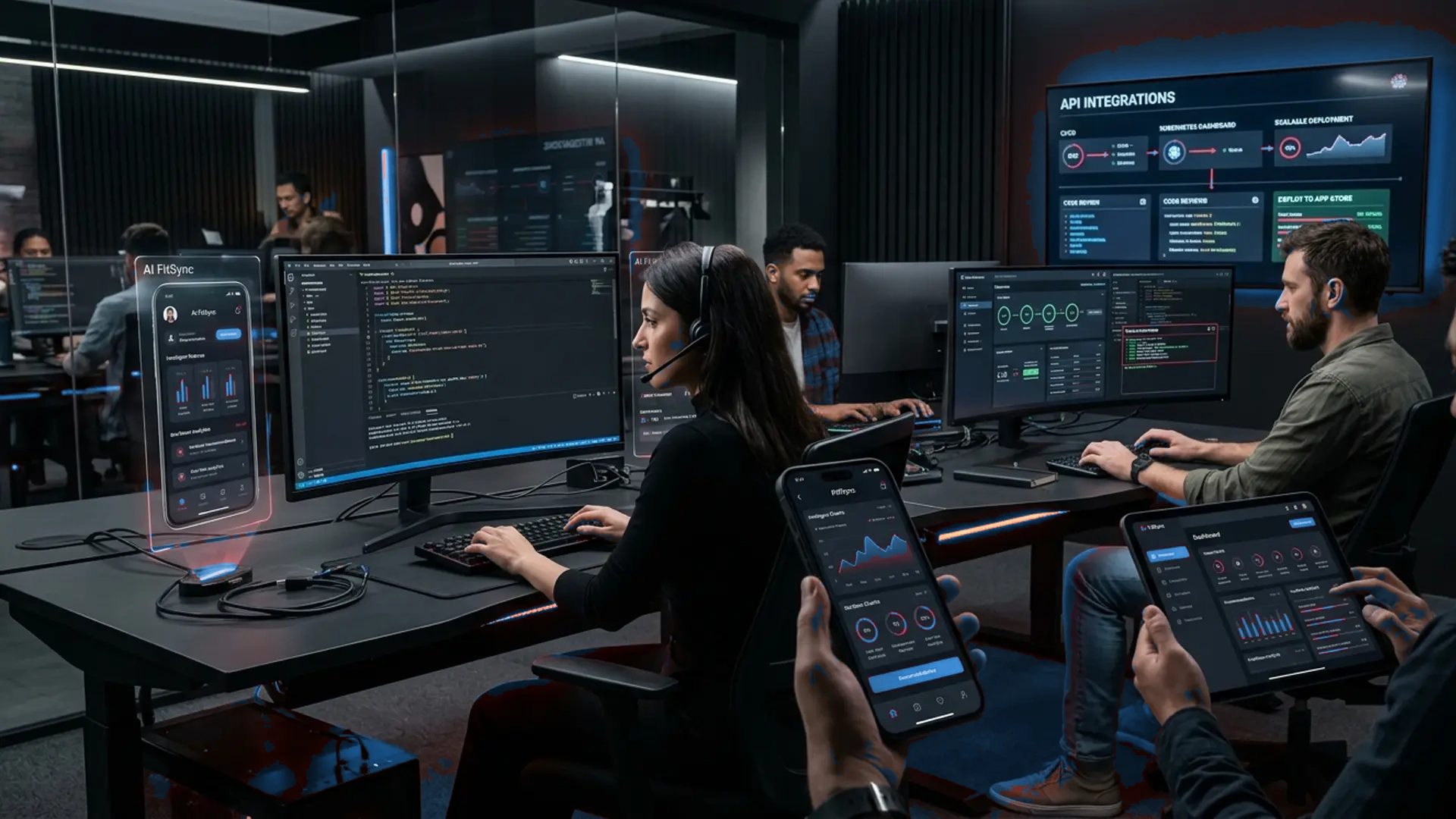
Full product builds where AI is core from mobile apps to enterprise SaaS with inference pipelines, billing, admin tooling, and UX designed for AI uncertainty.
AI app development ships complete applications not bolt-on AI experiments destined for a rewrite at scale. Auth, subscriptions, model routing, and feedback collection sit in the MVP scope alongside latency and cost profiles engineered for real user volumes from day one. Design patterns handle ambiguous, slow, or partial model responses calmly, and product analytics reveal which AI features drive engagement and revenue.
Product-Grade AI Applications
Authentication, subscriptions, and model routing are built into the foundation from sprint one not added after a prototype impresses stakeholders. Feedback collection loops enable continuous model and UX improvement, and admin tooling covers prompt management, usage monitoring, and access control.
Production infrastructure replaces prototypes destined for rewrite at scale ship-ready AI products with the operational depth investors and enterprise users expect.
Edge, Cloud, or Hybrid Inference
Models placed where privacy, speed, and unit economics make sense per feature.
On-device inference for latency-sensitive or offline-capable experiences.
Cloud APIs for complex generation tasks with caching to control costs.
Hybrid architectures routing requests to optimal inference endpoints dynamically.
Architecture decisions driven by real usage patterns not theoretical preferences.
Design for AI Uncertainty
Loading states and skeleton screens keep users informed during inference, with partial results and progressive disclosure when models stream responses. Retry paths and fallback content activate when models are slow or unavailable.
Clear expectations upfront help users understand AI limitations, and calm UX maintains trust even when AI performance varies uncertainty is a design problem, not just an engineering one.
Ship Metrics That Matter
Activation rates are tracked per AI feature to identify onboarding friction, and retention cohorts reveal which AI capabilities drive repeat usage. Task success metrics measure whether AI actually solves user problems not just whether users click the AI button.
Feature-level analytics guide investment toward high-impact capabilities, replacing intuition about AI feature value with data your product team can act on.
What you can expect from us
Step 01
Strategy
We plan with purpose, turning your goals into a clear roadmap.
We learn your business, audience, and goals, then shape a focused plan for what to build first.
Business analysis
Clear priorities
Phased roadmap
Step 02
Creativity
We bring fresh ideas and modern design so your product stands out.
Interfaces, visuals, and interactions are shaped to feel distinctive, clear, and true to your brand.
Distinctive design
Clear interactions
Brand-fit visuals
Step 03
Execution
We turn plans into reliable results, delivered with care and on time.
Design, engineering, and QA move in short cycles so progress stays visible and releases stay dependable.
Focused delivery
Quality checks
On-time releases
Step 01
Strategy
We learn your business, audience, and goals, then shape a focused plan for what to build first.
Business analysis
Clear priorities
Phased roadmap
Step 02
Creativity
Interfaces, visuals, and interactions are shaped to feel distinctive, clear, and true to your brand.
Distinctive design
Clear interactions
Brand-fit visuals
Step 03
Execution
Design, engineering, and QA move in short cycles so progress stays visible and releases stay dependable.